
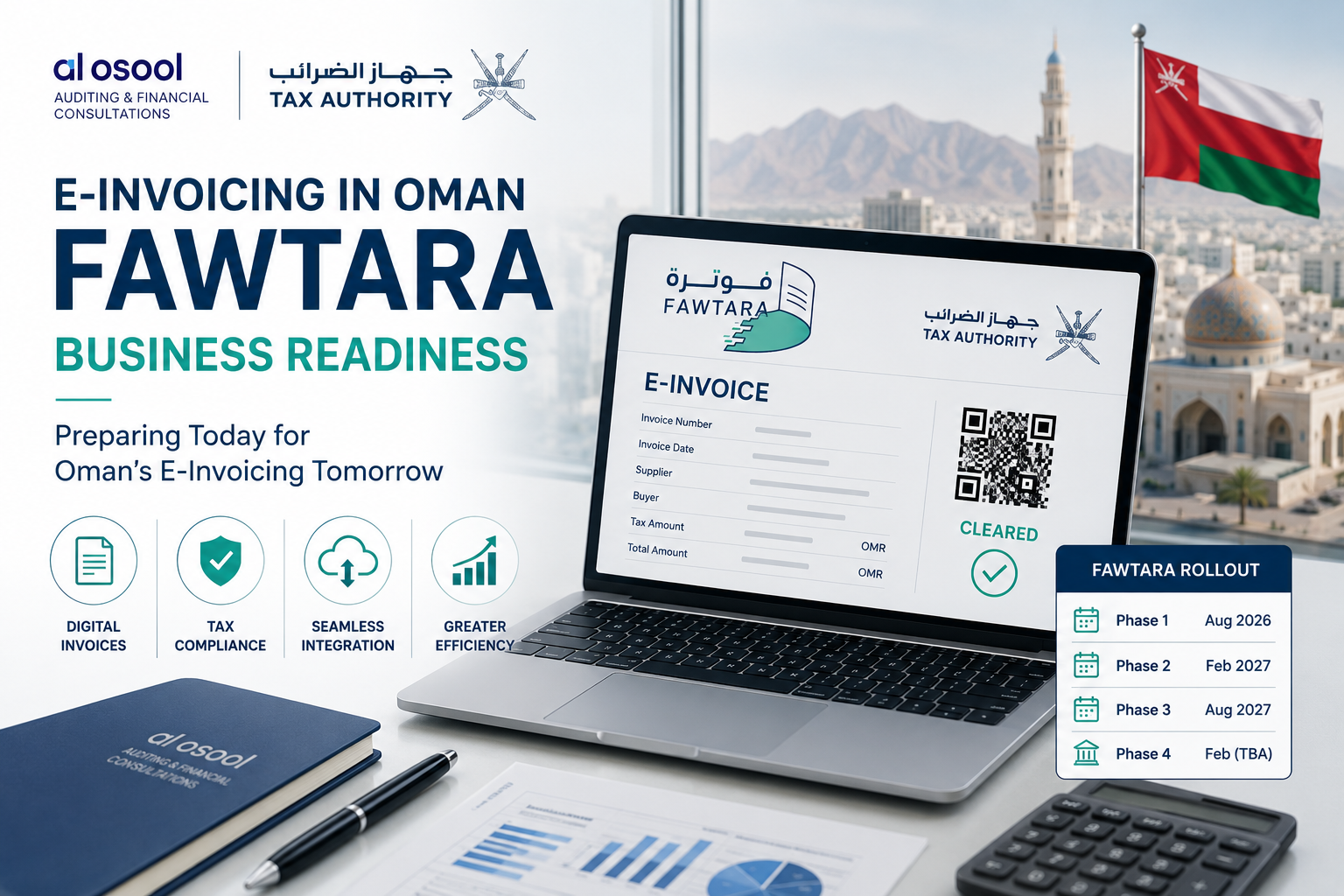
E-Invoicing in Oman: Fawtara Readiness for Businesses
The Sultanate of Oman is moving toward electronic invoicing through the Oman Tax Authority's Fawtara program. The initiative is designed to modernize tax compliance, reduce manual invoice errors, increase transaction transparency, and support the wider digital transformation of the Omani economy.
For businesses, e-invoicing should not be treated as only an IT change. It affects VAT compliance, invoice data quality, ERP and accounting systems, customer and supplier workflows, internal controls, and the way finance teams issue, receive, validate, and store tax invoices.
What is Oman e-invoicing?
Oman e-invoicing refers to issuing invoices in a structured electronic format through an approved electronic operating model. According to the Oman Tax Authority, the Fawtara system uses a 5-corner model for secure and standardized invoice exchange between suppliers, service providers, buyers, and the OTA.
In simple terms, the supplier issues the invoice through its service provider, the invoice is exchanged and validated through the buyer's service provider, the buyer receives the invoice data, and invoice information is also sent to the Oman Tax Authority system.
Who will be affected?
The OTA describes a phased implementation approach, with each stage targeting a specific taxpayer group. Based on the OTA e-invoicing page and FAQ information, the rollout stages are:
| Phase | Target Group | Implementation Timing |
|---|---|---|
| Phase 1 | 100 large VAT-registered companies | August 2026 |
| Phase 2 | All large VAT-registered companies | February 2027 |
| Phase 3 | All remaining VAT-registered taxpayers | August 2027 |
| Phase 4 | Government institutions and entities | February, year to be announced |
Latest Fawtara update
The latest published Oman Tax Authority Fawtara guidance adds practical requirements for taxpayers and accredited service providers. Businesses should use the latest OTA FAQ and portal manuals when planning their implementation.
- B2B e-invoices are to be submitted in real time, while B2C e-invoices are to be submitted within 24 hours.
- A QR code is required for all B2C transactions, including full and simplified invoices. It appears on the human-readable invoice, and the taxpayer is responsible for generating it.
- Each B2C transaction requires a separate e-invoice; consolidated B2C invoices are not allowed.
- After issuance, corrections should be made through an electronic credit note or debit note. Historical invoices do not need to be uploaded to OTA as part of e-invoicing.
- Taxpayers can select an accredited service provider and manage the connection through the Fawtara Portal. A service provider's request to disconnect a taxpayer requires the taxpayer to accept or reject it.
These points reflect the latest published FAQ and user-manual guidance. Earlier OTA FAQ pages still contain draft wording on some B2C and QR-code requirements, so businesses should also monitor the final e-invoicing legislation and direct OTA communications.
What changes after implementation?
Once official implementation applies to a business, invoices will need to be issued electronically using the prescribed structured format and a compliant solution connected through an accredited service provider. Invoices must be issued electronically rather than prepared manually and entered later.
For B2C transactions, the latest OTA FAQ states that a human-readable paper or PDF version may continue to be shared alongside the prescribed electronic invoice. The seller must still submit the required tax data through its service provider and ensure that the human-readable version follows OTA specifications, including the required QR code.
Why businesses should prepare now
Even if a business is not in the first rollout group, preparation should start early. Many practical issues take time to fix, especially invoice master data, VAT numbers, item descriptions, tax codes, customer details, approval workflows, accounting software configuration, and integration between sales, finance, and ERP systems.
- Review whether invoices currently contain all required VAT and commercial details.
- Clean customer, supplier, VATIN, item, and tax-code master data.
- Check whether the accounting or ERP system can support structured electronic invoice formats and API integration.
- Map the invoice lifecycle from quotation and delivery to invoice, credit note, payment, and record retention.
- Define who in the business will own invoice data quality and e-invoicing compliance.
- Monitor OTA rollout checking, official guidance, service-provider requirements, and technical specifications.
Readiness areas to review
A planned implementation supports steady operations. Important review areas include VAT data completeness, invoice numbering, invoice corrections, software compatibility, responsibility between finance and IT teams, and organized archiving of invoice evidence.
A readiness review can help identify these gaps before a mandatory rollout date applies. This is especially important for companies with multiple branches, high invoice volumes, different business lines, import/export transactions, or existing ERP customizations.
How Al Osool can help
Al Osool supports businesses in Oman with VAT compliance, accounting process reviews, invoice documentation checks, finance workflow improvements, ERP/accounting system readiness, and practical implementation planning for digital tax compliance.
For support with e-invoicing readiness in Oman, visit our Taxation-Related Services, Accounting Services, or AI & Technology Integration pages, or contact Al Osool.